Research & Intelligence · Opportunity Signals · Independent project
Which signals from human experience are worth carrying into the next round of research?
Julius works with unstructured material about people and their experiences. Instead of treating fluent summaries as insight, it retains a source_id and verbatim quotation before deciding whether a signal is traceable, reusable and worth further investigation.
This is a prototype for organising research material and tracing judgments. Clustered themes are not treated as conclusions.
Decision Context
More material does not make an insight usable.
Interviews, talks and discussions contain many observations. If a claim cannot be traced back to its source, it is difficult to decide whether it should enter the next research cycle or be reused in later content and experiments.
Question / Alternatives
What should qualify as a research asset?
Store claims without sources
Fast, but it mixes unverifiable inference into the research record.
Require provenance
Every insight must retain a source_id and verbatim quotation. Signals with insufficient evidence stay at the intake stage.
Workbench decision
Retain the source and the judgment process first; then decide whether a signal should inform a topic, an output or a new experiment.
Evidence / Validation
Provenance is the first validation gate.
Hard constraint
An insight without a source_id and verbatim quotation does not enter the research base.
Two-way traceability
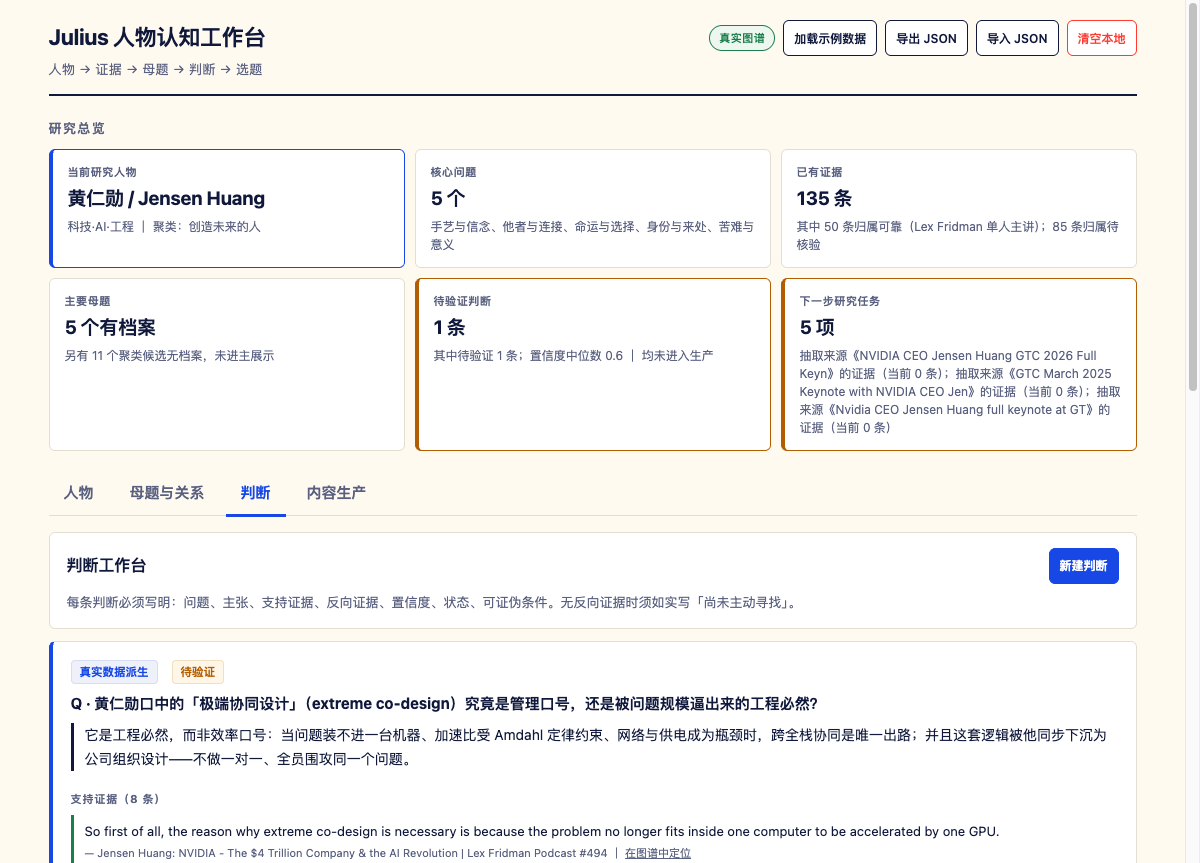
A topic can be traced back to the judgment, evidence and source; evidence can also be traced forward to judgments and topics.
Real graph data
The current graph contains 216 nodes and 385 relationships. The public page shows only real data and its source structure.
Recommendation
Only traceable insights move forward.
A signal without a source should not enter the research base or be presented as a settled conclusion. This reduces the risk of continuing to invest in noise mistaken for insight.
Artifact
The graph and workbench demonstrate the method, not decoration.
The graph below uses real project data. Relationships between people, clustered themes, concepts and sources can be inspected. The static workbench demonstrates the information architecture; public knowledge retrieval is not yet deployed.
Loading graph data…
Boundary / Next Action
The next step is to add examples, not expand the graph.
What we cannot claim
There are no public quantitative outcomes and no settled conclusions about a content product, account direction or what should be explored next.
Next step
Add two or three redacted material → insight → destination examples, then assess which signals deserve further research.